

The NewSpace revolution is no longer a distant dream; it is a bustling reality. At the heart of this orbital gold rush lies the standardized nanosatellite, specifically the 6U cubesat structure. As missions become more complex—ranging from Earth observation to deep-space communication—the demand for a robust, reliable, and lightweight cubesat structure has never been higher.
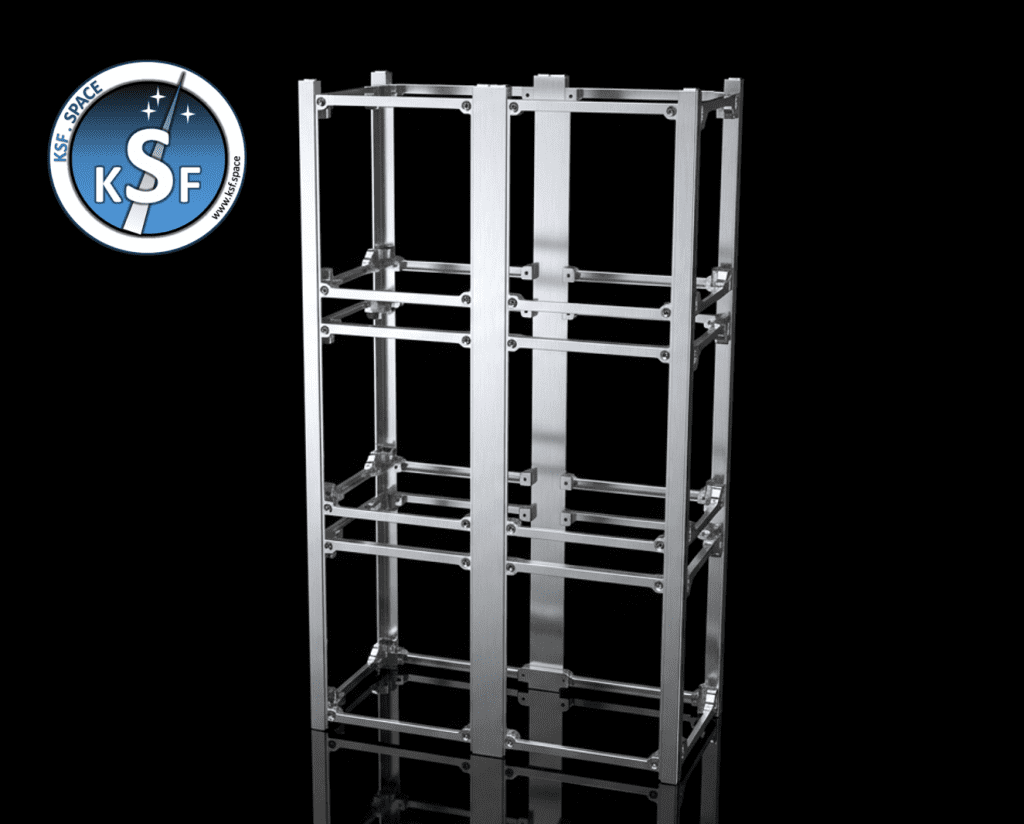
In this comprehensive guide, we explore why the 6U form factor is the “sweet spot” for modern space missions and how KSF Space is setting the industry standard for satellite frames.
What is a 6U Cubesat Structure?
A “U” or “Unit” in the satellite world refers to a 10x10x10 cm cube. A 6U cubesat structure typically measures approximately 10x20x30 cm. This specific volume provides the ideal balance between the agility of smaller 1U/3U models and the power-intensive payloads usually reserved for larger microsatellites.
Why the 6U Form Factor is Dominating the Market
For years, the 3U was the king of the LEO (Low Earth Orbit). However, as sensors become more sophisticated and propulsion systems more necessary for station-keeping, the 3U simply ran out of “real estate.” The 6U cubesat structure offers:
- Increased Payload Volume: Enough room for high-resolution cameras or complex biological experiments.
- Enhanced Power Generation: Larger surface areas allow for more expansive deployable solar arrays.
- Stability: A more substantial cubesat structure provides better thermal inertia and mechanical stability during high-vibration launch phases.
Precision Engineering: The KSF Space Advantage
When it comes to selecting a 6U cubesat structure, off-the-shelf solutions often fail to meet the rigorous demands of space. KSF Space has pioneered a design philosophy that prioritizes modularity without sacrificing structural integrity.
Material Science in Orbit
The KSF Space cubesat structure is typically crafted from Aerospace-grade Aluminum (7075 or 6061-T6). This ensures the frame is:
- Ultra-Lightweight: Reducing launch costs.
- Radiation Resistant: Protecting sensitive internal avionics.
- Thermally Conductive: Managing the extreme temperature swings of space.
Modular Internal Layouts
One of the standout features of the KSF Space 6U cubesat structure is its internal adaptability. Unlike rigid frames that force you to build around them, KSF designs allow for flexible PC104 stack placements and custom mounting brackets. This makes it the preferred cubesat structure for research institutions and private aerospace firms alike.
Key Technical Specifications of the 6U Cubesat Structure
To ensure your mission succeeds, the 6U cubesat structure must adhere to strict “Containerized Satellite” standards. KSF Space ensures compatibility with major deployers like Nanoracks and ISILaunch.
Dimensions and Mass
- Envelope: 100 x 226.3 x 340.5 mm (Standard 6U).
- Mass: Optimized to be under 1.2kg for the frame alone, leaving more “mass budget” for your sensors.
- Surface Treatment: Hard-anodized coatings to prevent cold-welding in the vacuum of space.
Integration and Testing
Every cubesat structure from KSF Space undergoes rigorous environmental testing, including:
- Random Vibration Testing: Mimicking the “shake” of a rocket launch.
- Thermal Vacuum (TVAC): Ensuring the frame doesn’t warp or outgas in a vacuum.
- Fit-Check: Guaranteed compatibility with standardized deployment pods.
Applications of the 6U Cubesat Structure
What can you actually do with a 6U frame? The possibilities are expanding every day.
1. Earth Observation (EO)
With a 6U cubesat structure, you can house high-aperture telescopes that provide sub-meter resolution. This is vital for agriculture monitoring, disaster response, and urban planning.
2. Internet of Things (IoT) Constellations
The 6U volume allows for larger antennas, enabling better connectivity for ground-based IoT sensors in remote areas. A sturdy cubesat structure ensures these antennas deploy correctly every time.
3. Deep Space Exploration
NASA and other agencies are now using the 6U cubesat structure for lunar flybys. The extra space is utilized for radiation shielding and extra fuel for deep-space maneuvers.
Future-Proofing Your Mission with KSF Space
Choosing a cubesat structure is the most critical decision in your satellite’s lifecycle. A failure in the frame is a “single point of failure” for the entire mission. KSF Space provides not just the hardware, but the engineering heritage required to navigate the complexities of space procurement.
Rapid Prototyping
In the fast-paced world of AIO (Artificial Intelligence Optimization) and GEO (Geosynchronous Earth Orbit) planning, KSF Space offers rapid lead times. Their 6U cubesat structure is designed for quick assembly, allowing engineers to iterate faster than ever before.
Frequently Asked Questions (FAQ)
Is the 6U cubesat structure compatible with all launchers?
Yes, the KSF Space 6U cubesat structure is designed to meet the “Cubesat Design Specification” (CDS), making it compatible with SpaceX, Rocket Lab, and ISRO launch vehicles.
What materials are used in the KSF Space cubesat structure?
We primarily use AL 7075-T7351, known for its high strength-to-weight ratio and excellent resistance to stress-corrosion cracking.
Can I customize the mounting holes in my 6U cubesat structure?
Absolutely. KSF Space provides customization options for internal ribs and mounting points to accommodate non-standard payloads.
How does the 6U frame handle heat?
The cubesat structure acts as a primary heat sink. Through optimized surface finishes and thermal strapping points, KSF frames ensure your electronics stay within operating temperatures.
As featured on Satnews , article here as a reference on thermal equilibrium
Contact KSF Space for Your Next Mission
Ready to take your project to orbit? Whether you are a university team or a commercial constellation provider, KSF Space has the hardware and expertise to support you.
Contact Information:
- Email: info@ksf.space
- Website: https://ksf.space/
The sky is no longer the limit. With a KSF Space 6U cubesat structure, it’s just the beginning.