

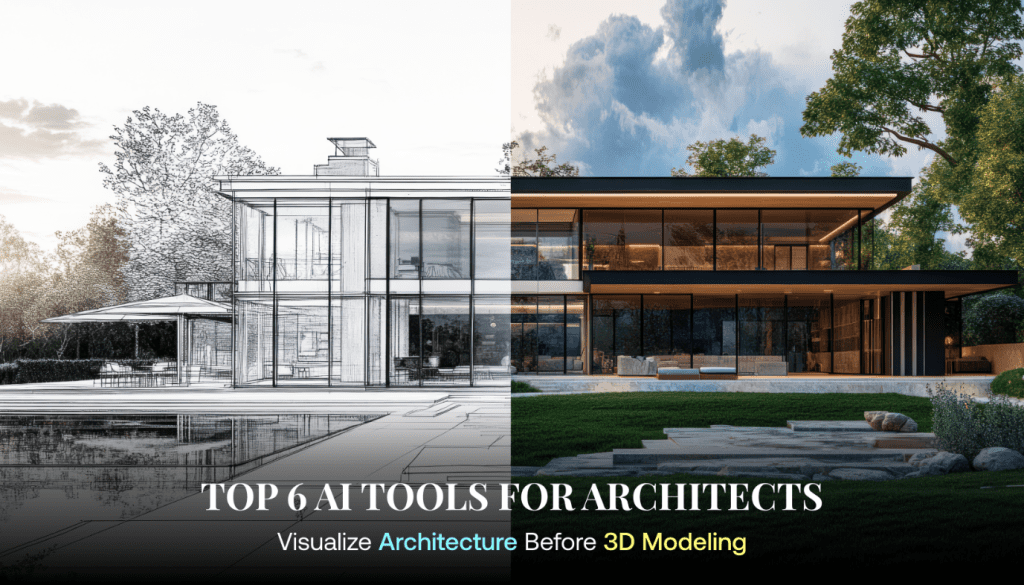
The early stage of architecture has always been the most exciting and the most chaotic.
Ideas move faster than software. Clients want visuals before details exist. Teams need direction before committing to weeks of 3D modeling. And somewhere between napkin sketches and polished renders, architects are expected to “show something realistic.”
That’s where AI tools for architects are quietly transforming workflows.
Instead of jumping straight into Revit, Rhino, or SketchUp, many firms now use AI architectural visualization software to test massing, materials, lighting, and spatial concepts in minutes. What once took days of modeling can now be explored in rapid iterations.
This isn’t about replacing architects. It’s about accelerating imagination.
Below are the 6 best AI tools for architects to visualize concepts before 3D modeling especially relevant in the era of AI concept design tools 2026 and evolving architecture workflow automation.
The Most Relevant AI Architecture Platforms in 2026
The landscape of architectural AI software has matured significantly. The tools gaining real traction in 2026 are not generic image generators they’re workflow-aligned platforms.
1. Leonardo AI
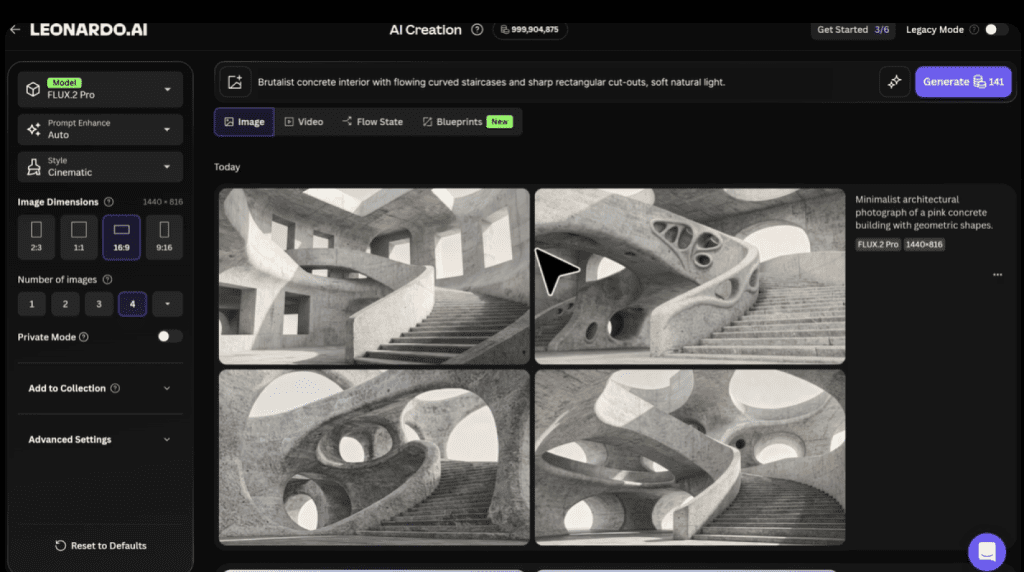
Leonardo AI has quickly become popular among creative professionals for high-quality generative imagery and architects are using it to experiment with form, façade articulation, lighting moods, and environmental settings.
What It Does Well
- Text-to-image architectural concept generation
- Style-driven experimentation (brutalist, parametric, minimal, biophilic, etc.)
- Fast mood board creation
- Iterative façade studies
Architects use Leonardo AI as one of the more flexible AI rendering alternatives during early ideation.
Instead of modeling a complex structure, they can prompt-
“Futuristic cultural center with perforated façade, sunset lighting, desert context.”
Within minutes, multiple stylistic directions emerge.
Where It Fits in Workflow
- Pre-client pitch visuals
- Design competitions
- Concept exploration
- Internal brainstorming
It doesn’t understand technical constraints like structural loads or code compliance but for visualize architecture before modeling, it performs impressively.
2. RenoAI

RenoAI is one of the leading AI powered tool for Architectural design, it is built specifically for spatial visualization not generic image generation.
While many AI platforms create artistic renders, RenoAI focuses on architectural intent.
Why RenoAI Is Architect-Centric
RenoAI enables architects to-
- Transform rough sketches, plans, or reference visuals into styled spatial concepts
- Instantly test material palettes across interiors and exteriors
- Explore lighting moods and contextual environments
- Generate retail, landscape, office, residential, and façade concepts
- Present multiple visual directions before committing to 3D geometry
Unlike generic AI rendering alternatives, RenoAI is structured around architectural use cases, early client conversations, feasibility discussions, pitch decks, and developer presentations.
Where RenoAI Fits in Workflow
Instead of jumping into Revit or Rhino, architects can-
Concept idea → RenoAI visualization → Refined direction → Focused 3D modeling
This reduces early modeling waste and speeds up decision alignment.
For firms looking to visualize architecture before modeling, RenoAI acts as a rapid pre-visualization engine bridging imagination and structured design development.
In the landscape of AI concept design tools 2026, RenoAI represents a shift toward workflow-aligned architectural AI rather than general-purpose generative imagery.
3. Veras (AI Visualization)
Veras is specifically built for architects and integrates directly with modeling tools like SketchUp and Revit.
Unlike generic AI image tools, Veras works with geometry you already have.
Why Architects Like It
- Converts rough 3D models into realistic renders
- Applies material styles instantly
- Maintains geometry integrity
- Helps compare design variations quickly
This makes it strong AI architectural visualization software rather than just generative art.
If you’ve built a simple massing model, Veras can-
- Add façade detailing
- Adjust lighting scenarios
- Explore material palettes
- Test contextual environments
For firms asking whether AI visualization is accurate enough for professional architects’ tools like Veras show that geometry-aware AI can deliver credible outputs for presentations.
4. Maket.ai
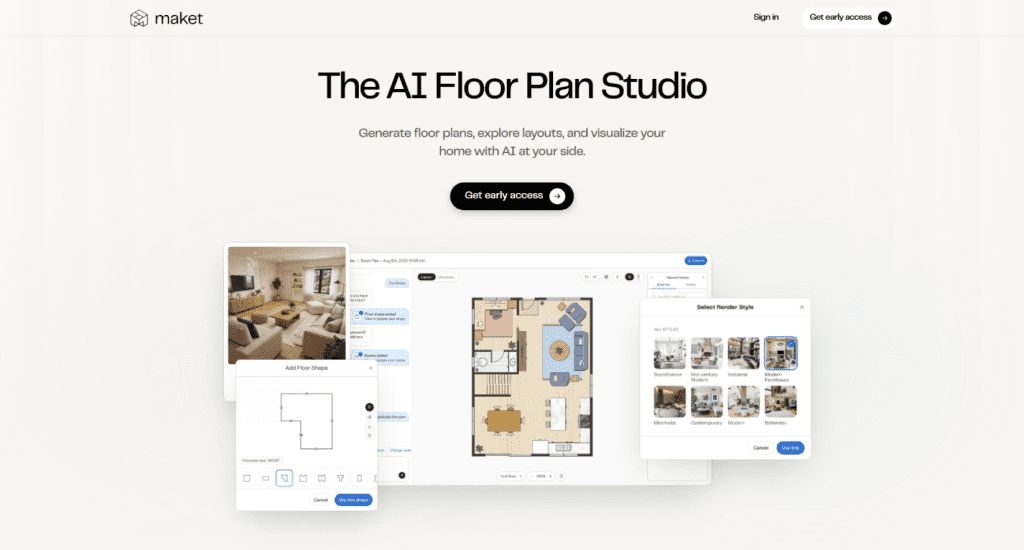
Maket.ai focuses on layout generation and spatial planning a fascinating application of architectural AI software.
It generates floor plan concepts based on input parameters such as-
- Plot dimensions
- Zoning requirements
- Room counts
- Functional preferences
Why It Matters
Instead of manually sketching five layout options, Maket.ai can produce multiple structured arrangements instantly.
This supports-
- Residential design exploration
- Developer feasibility studies
- Rapid test-fit exercises
For firms working on volume housing or early feasibility projects, Maket.ai becomes one of the more powerful pre-visualization tools for architects.
Does it replace architectural thinking? No.
But it gives architects more variations to refine and clients appreciate seeing structured options quickly.
5. mnml.ai
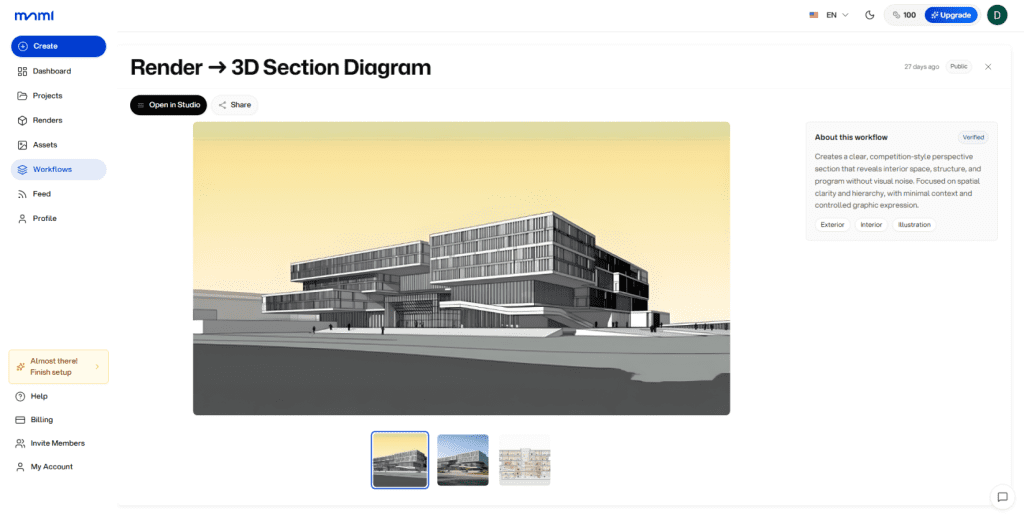
mnml.ai focuses on transforming sketches or rough models into photorealistic imagery.
Its strength lies in visual refinement.
Upload-
- A sketch
- A Rhino massing model
- A conceptual façade outline
And mnml.ai generates presentation-ready visuals.
Why It’s Useful
- Helps architects test multiple design aesthetics
- Converts low-detail models into compelling renders
- Speeds up concept presentation decks
For firms preparing competitions, mnml.ai reduces the pressure of fully detailing models too early.
In the context of AI design platforms for architects, it acts as a visual amplifier turning basic geometry into emotionally persuasive imagery.
6. MyArchitectAI
MyArchitectAI focuses on rapid architectural visualization and concept imagery generation.
It allows architects to-
- Upload rough plans
- Apply stylistic filters
- Generate interior and exterior concept renders
Its appeal lies in speed and simplicity.
For small firms or solo architects, it functions as an accessible entry into AI architectural visualization software without steep technical complexity.
It’s particularly useful for-
- Residential concept previews
- Interior renovation mockups
- Fast design mood boards
How AI Is Actually Being Used in Early-Stage Architecture?
The biggest misconception about AI in architecture is that it’s a rendering gimmick.
In reality, architects are using AI much earlier in the process during ideation, spatial testing, and conceptual storytelling.
Instead of building full geometry immediately, designers now:
- Generate façade studies from text prompts
- Test material palettes on rough massing models
- Explore lighting scenarios without setting up render engines
- Create multiple stylistic directions before committing to one
This shift allows architects to explore more creative territory in less time. AI becomes a rapid visualization layer that sits before technical modeling.
It’s not replacing architectural thinking. It’s accelerating conceptual exploration.
Read More: 5 Ways to Improve Your Home’s Interior
AI and Early-Stage 3D Modeling: Replacement or Reinforcement?
There’s a lot of noise around whether AI makes 3D modeling obsolete.
It doesn’t.
BIM coordination, construction documentation, structural integration, and compliance workflows still require precise modeling tools like Revit, ArchiCAD, or Rhino.
What AI does eliminate is unnecessary early modeling cycles.
Instead of:
Model → Render → Adjust → Remodel → Re-render
Architects can now:
Generate → Compare → Refine direction → Then model intentionally
AI narrows the field of possibilities before heavy geometry work begins. That reduces wasted effort and improves design clarity before time-intensive modeling starts.
Think of AI as a conceptual filter, not a modeling replacement.
Why AI Has Become a Presentation Accelerator?
Client presentations used to depend heavily on how much modeling was completed.
Now, early-stage meetings look different.
Architects walk in with:
- Multiple façade directions
- Different material palettes
- Contextual lighting scenarios
- Interior mood variations
All created before detailed geometry is finalized.
AI dramatically reduces rendering turnaround time. Instead of waiting days for visual polish, teams can prepare multiple compelling visual narratives in hours.
That improves persuasion.
It improves clarity. And it increases client confidence early in the engagement.
Is AI Visualization Reliable for Professional Use?
This is where nuance matters.
AI-generated visuals are not technical drawings. They should never be mistaken for construction-ready documentation.
But for concept validation and stakeholder communication, they are more than sufficient.
Geometry-aware tools like Veras maintain massing integrity. Layout generators like Maket.ai follow spatial logic. Concept visualization platforms like RenoAI produce architecturally coherent outputs when guided properly.
Accuracy depends on:
- The quality of input
- The clarity of prompts
- The architect’s ability to interpret outputs
AI does not remove professional judgment. It amplifies it.
When used strategically, AI-generated visuals can reach a level of quality that comfortably supports investor decks, early approvals, and internal design alignment.
What This Means for Architectural Practice?
The adoption of AI concept design tools in 2026 is less about novelty and more about workflow intelligence.
Architects are under pressure to:
- Deliver faster
- Compete in more design bids
- Communicate more visually
- Reduce wasted modeling time
AI helps them do exactly that.
It supports architectural workflow automation by compressing the gap between imagination and visualization.
And the firms embracing it early are discovering something important:
Speed does not reduce creativity.
It increases experimentation.
What Makes a Great AI Tool for Architects in 2026?
When evaluating AI concept design tools 2026, architects should consider-
- Does it integrate with existing workflow?
- Does it respect geometry constraints?
- Can it generate multiple variations quickly?
- Is output quality presentation-ready?
- Does it save measurable time?
The best architectural AI software doesn’t just create pretty images. It supports decision-making.
Conclusion
Architecture has always evolved alongside technology.
From drafting tables to CAD.
From CAD to BIM.
From BIM to computational design.
Now we are entering the era of generative AI for architecture.
The six tools discussed Leonardo AI, Veras, Maket.ai, mnml.ai, RenoAI, and MyArchitectAI represent different layers of this transformation.
Some focus on imagery.
Some on layout.
Some on geometry refinement.
Some on workflow acceleration.
Together, they redefine how architects visualize architecture before modeling.
The future of architecture isn’t AI versus architects.
It’s architects are amplified by AI.
And in 2026, firms that master these pre-visualization tools for architects will move faster, communicate better, and design with greater confidence than ever before.
FAQs
How can AI tools support architectural concept development?
AI tools help architects generate visual directions, test materials, explore layouts, and refine ideas quickly before committing to detailed 3D modeling.
What advantages does AI pre-visualization offer over traditional methods?
AI enables rapid iterations, multiple design variations, faster presentations, and reduced early modeling time compared to traditional workflows.
Can AI tools generate multiple design variations instantly?
Yes. Most AI design platforms can produce multiple visual or layout variations within minutes based on prompts or input parameters.
Are AI architectural platforms suitable for large projects?
Yes, especially during feasibility and conceptual stages. They support large-scale ideation before transitioning into BIM and technical modeling tools.
How do AI tools improve communication with clients during early stages?
AI-generated visuals make abstract concepts tangible, helping clients understand spatial intent, material direction, and overall design mood clearly.