
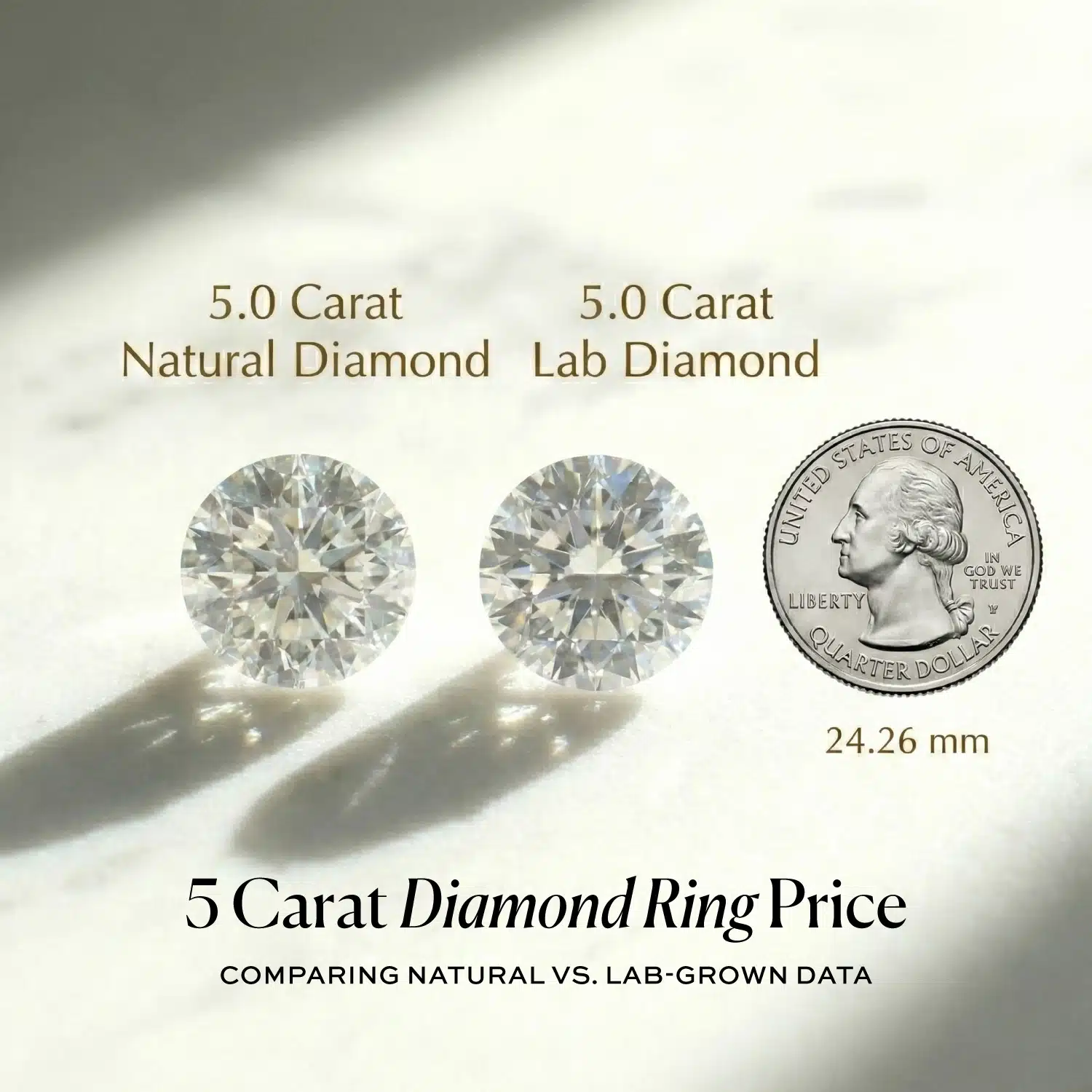
Pricing a 5-carat diamond ring feels like buying real estate. The numbers are massive, and the market is entirely opaque. A single misstep in clarity or shape selection can easily cost you $40,000.
We analyzed the 2026 market data across top retailers to give you the exact numbers. Here is the undeniable math behind natural versus lab-grown 5-carat diamonds.
👉 5 Carat Diamond Ring Price for USA
The 2026 Price Snapshot: What Does a 5-Carat Diamond Cost?
You want the bottom line. Here is exactly what you can expect to spend this year.
- Natural (Entry-Level): $119,440 (GIA H-VS1)
- Natural (Investment-Grade): $600,000+ (GIA D-IF)
- Lab-Grown (High-End): $6,000 to $20,000 (GIA F-VS1)
The price gap is staggering. But understanding why requires looking at how these stones are sourced.
The Rarity Wall: Why Natural 5-Carat Diamonds Cost $100k+
Earth-mined diamonds hit a “rarity wall.” Moving from 4 carats to 5 carats is not a linear 20% price increase. It is an exponential leap.
Finding rough crystals large enough to cut a perfect 5-carat stone is incredibly rare. You are paying for that geological scarcity. These stones cross into the realm of liquid assets, often trading hands at auction houses like Sotheby’s.
The Lab-Grown Reality: Flawless 5-Carat Rings for Under $20k
Lab-grown diamonds shatter the rarity wall. Because they are grown via CVD or HPHT methods, supply is not restricted by nature.
This drops the 5-carat lab-grown diamond price to a fraction of its natural counterpart. You get the exact same physical, chemical, and optical properties. The only difference is the origin, which translates to massive upfront savings. However, this lack of scarcity means lab diamonds suffer heavy depreciation.
Shape Economics: How to Save $40,000 on a 5-Carat Diamond
You do not have to sacrifice size to lower your budget. You just need to change the shape.
Round Brilliant diamonds suffer from the “Round Tax.” Cutters waste up to 60% of the rough diamond to achieve that perfect circle. You pay for that wasted material. Fancy shapes like the Radiant or Marquise cut use the rough stone much more efficiently.
5-Carat Natural Diamond Price Comparison (G-VS2 Specs)
| Diamond Shape | Average Market Price | Savings vs. Round | Visual Impact |
| Round Brilliant | $143,260 | $0 (Benchmark) | 11.1mm Diameter |
| Oval Cut | $121,080 | -$22,180 | Elongated, looks larger |
| Radiant Cut | $113,300 | -$29,960 | “Crushed Ice” modern look |
| Marquise Cut | $96,000 | -$47,260 | Maximum face-up area |
A 5-carat Marquise actually has a larger face-up area than a Round. You get a ring that looks bigger while saving nearly $50,000.
Quality Control: Why GIA Certification is Mandatory at 5 Carats
Never buy a 5-carat natural diamond without a certificate from the Gemological Institute of America (GIA). Other labs often inflate grades.
An SI1 clarity grade from a lesser lab might actually be an I1 by GIA standards. In a 5-carat stone, the large surface area acts like a window. That grading error results in a highly visible, ugly inclusion. It is an SI1 disaster that ruins the stone’s brilliance and plummets its replacement value.
The Aurelia Verdict: Asset or Lifestyle Purchase?
Your decision ultimately comes down to your financial exit strategy. Are you parking capital or buying a luxury experience?
Natural 5-carat diamonds are resale assets. They hold significant value over time. Lab-grown diamonds are lifestyle luxuries. They offer unmatched beauty for the price, but they depreciate immediately.
If you want the breathtaking scale of a 5-carat ring without tying up $150,000 in capital, Aurelia offers the ultimate lifestyle solution. Our curated selection of premium lab-grown and moissanite alternatives delivers the exact visual impact you want, keeping your capital free for other investments.
Frequently Asked Questions
How much does a 5 carat diamond ring cost?
In 2026, a natural 5-carat diamond ring costs between $119,000 and $600,000+. Conversely, a high-quality 5-carat lab-grown diamond ranges from $6,000 to $20,000.
The drastic price difference is driven entirely by the rarity of large earth-mined rough crystals. Lab diamonds offer identical optics without the scarcity premium.
Is a 5 carat lab-grown diamond real?
Yes, lab-grown diamonds are physically, chemically, and optically identical to earth-mined diamonds. They consist of pure crystallized carbon and pass all standard diamond tester equipment.
The only distinction is their origin. They are grown in highly controlled laboratory environments using CVD or HPHT processes rather than mined from the earth.
How big is a 5 carat diamond on a hand?
A 5-carat round brilliant diamond measures approximately 11.1mm in diameter. On an average size 6 finger, this stone covers roughly 70% of the finger’s width.
This creates a massive visual profile. If you choose an elongated shape like an Oval or Marquise, the stone will appear even larger and cover more surface area.
Why are 5 carat natural diamonds so uniquely expensive?
Natural 5-carat diamonds are priced exponentially higher due to extreme geological scarcity. Finding an earth-mined rough crystal large and clean enough is exceptionally rare.
Because of this rarity, 5-carat natural stones leave the standard consumer retail market and enter the “auction-grade” asset category, which drastically inflates their price per carat.
Which 5 carat diamond shape looks the biggest?
Elongated fancy shapes like the Marquise, Oval, and Pear cuts look the largest per carat. They have a much larger face-up area than a Round Brilliant.
By opting for a Marquise cut, you maximize the visual spread of the diamond on the finger while simultaneously taking advantage of lower per-carat pricing.
