

3D Animation Market Scope and Overview
The 3D Animation Market has seen exponential growth over the past few years, driven by advancements in technology, growing demand in various industries, and the increasing use of animated visuals in media, entertainment, and other sectors. 3D animation allows for the creation of detailed, lifelike visuals that captivate audiences, making it a crucial tool for businesses and professionals looking to engage and communicate with their target audience effectively. With an expanding application scope, the market is expected to continue its upward trajectory, offering opportunities for both established players and new entrants. This article explores the competitive landscape, market segmentation, and strengths of the 3D animation market.
The 3D Animation market involves software and tools that allow for the creation of three-dimensional digital content for various industries, including entertainment, gaming, architecture, and education. Advances in technology, such as real-time rendering and motion capture, have expanded the use of 3D animation in fields like advertising, virtual reality, and scientific visualization. The market is growing as demand increases for visually engaging content in films, video games, and marketing campaigns. Additionally, the integration of AI and machine learning in animation tools is expected to revolutionize the creation process.
Competitive Analysis
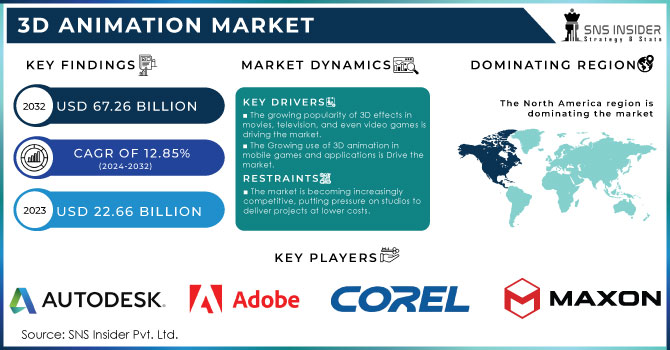
The 3D animation market is highly competitive, with numerous key players driving innovation and pushing the boundaries of what is possible in animation. Major companies like Autodesk, Adobe Systems Incorporated, Corel Corporation, Maxon Computer, and Pixologic Inc are at the forefront of delivering cutting-edge software solutions. These companies have a strong foothold due to their extensive portfolios, which cater to diverse industries ranging from media and entertainment to healthcare and education.
Other key players such as NVIDIA Corporation, Newtek Inc, Sidefx Software, and The Foundry VisionMongers Ltd specialize in providing hardware and rendering solutions that enhance animation performance, ensuring faster processing and better output. These companies focus on optimizing the technical aspects of animation, allowing creators to produce highly detailed and realistic animations more efficiently.
Emerging firms like Zco Corporation are also making their mark by offering specialized services that cater to niche markets and specific client needs. They leverage modern tools, including AI and cloud-based technologies, to streamline workflows and increase accessibility for smaller enterprises or individual creators.
With constant product updates, acquisitions, and strategic partnerships, companies in this space are continuously innovating to maintain a competitive edge. The integration of artificial intelligence (AI), virtual reality (VR), and augmented reality (AR) has also brought a new dimension to the industry, enhancing the capabilities of 3D animation across different sectors.
3D Animation Market Segmentation
The 3D animation market can be segmented by technique, component, organization size, deployment model, and end-use. Each segmentation allows for a deeper understanding of how 3D animation is used across various industries and applications.
On the Basis of Technique
- 3D Modeling: This involves creating a digital three-dimensional representation of objects or characters. It is widely used in industries like media, gaming, architecture, and automotive design. 3D modeling helps in visualizing and prototyping products before they are manufactured, reducing errors and saving time.
- Motion Graphics: Motion graphics combine animation and graphic design to create dynamic visuals. This technique is commonly used in marketing, entertainment, and advertising, allowing brands to convey messages in an engaging and visually appealing manner. It is popular due to its ability to integrate with 2D designs and bring static elements to life.
- 3D Rendering: Rendering is the process of converting 3D models into high-quality images or videos. Industries like architecture and product design heavily rely on 3D rendering to showcase realistic representations of their concepts. Advanced rendering techniques have reduced processing times, allowing creators to produce detailed animations more efficiently.
- Visual Effects (VFX): VFX involves creating realistic special effects for films, games, and television. It has revolutionized media and entertainment, enabling filmmakers and content creators to build immersive worlds and characters. VFX is also finding applications in healthcare, education, and other industries where visualization is critical.
On the Basis of Component
- Hardware: This includes the physical systems required to create 3D animations, such as workstations, graphics processing units (GPUs), and rendering servers. The hardware component is crucial for processing large data sets and handling the computational requirements of 3D animation.
- Software: Software solutions are essential tools for creating, editing, and rendering 3D animations. Major software products include Autodesk’s Maya and 3ds Max, Adobe’s After Effects, and Maxon’s Cinema 4D. These platforms offer a wide range of features, allowing animators to build complex animations with precision and efficiency.
- Services: The services segment includes consulting, integration, support, and maintenance services offered by animation companies or third-party vendors. These services help organizations implement 3D animation solutions effectively, ensure seamless integration with existing systems, and provide ongoing technical support.
By Organization Size
- Small and Medium-sized Enterprises (SMEs): SMEs are increasingly adopting 3D animation solutions to enhance their marketing strategies, develop prototypes, and create training materials. Cloud-based and on-demand software solutions make 3D animation more accessible for smaller enterprises with limited budgets, enabling them to compete with larger organizations.
- Large Enterprises: Large companies, particularly in industries like entertainment, architecture, and manufacturing, have substantial resources to invest in advanced 3D animation technologies. They often deploy on-premise solutions to ensure high levels of security, control, and customization in their animation workflows.
On the Basis of Deployment
- On-Premise: On-premise deployment refers to software and hardware solutions that are hosted on the company’s internal infrastructure. This deployment model is preferred by large organizations that require greater control over their animation processes and data security. On-premise solutions are ideal for companies that deal with sensitive information, such as government projects or high-budget film production.
- On-Demand: On-demand, or cloud-based, solutions allow users to access 3D animation software through the cloud. This model is particularly popular among SMEs and freelancers, as it reduces the need for expensive hardware and provides flexibility. Cloud solutions also facilitate collaboration among distributed teams, making it easier to work on large-scale animation projects remotely.
On the Basis of End-use
- Media & Entertainment: The media and entertainment industry is the largest consumer of 3D animation. Films, television, and video games extensively use 3D animation for creating characters, environments, and visual effects. With the rise of streaming platforms and increased consumption of digital content, the demand for high-quality 3D animation continues to grow.
- Architecture & Construction: 3D animation is increasingly used in architecture to create realistic visualizations of buildings and infrastructure projects. It helps architects, engineers, and clients visualize the final structure before construction begins, enabling better planning and decision-making.
- Education & Academics: Educational institutions use 3D animation to create interactive learning experiences. Animated videos and simulations help explain complex concepts, particularly in subjects like biology, physics, and engineering, enhancing student engagement and comprehension.
- Manufacturing: In the manufacturing sector, 3D animation is used for product design, simulation, and prototyping. Companies can visualize the entire product lifecycle, from concept to production, reducing development times and minimizing errors.
- Healthcare & Life Sciences: 3D animation is revolutionizing healthcare by providing detailed visualizations of the human body, surgical procedures, and medical devices. It is used for patient education, training healthcare professionals, and assisting in research and development.
- Government & Defense: Government agencies and defense organizations use 3D animation for training simulations, visualizing battle scenarios, and developing communication materials. The technology helps improve decision-making and operational efficiency in complex environments.
- Others: Other sectors utilizing 3D animation include marketing, retail, and automotive. Companies in these industries use animation for advertising, product demonstrations, and customer engagement.
Strengths of the 3D Animation Market
The 3D animation market’s strengths lie in its versatility and its ability to create engaging, immersive experiences across various industries. The integration of AI, VR, and AR technologies has expanded its potential applications, allowing for more interactive and lifelike animations. Additionally, the rise of cloud-based solutions has made 3D animation more accessible to SMEs and individual creators, further driving market growth.
3D animation’s ability to streamline processes, enhance visual communication, and improve decision-making makes it an invaluable tool in industries like manufacturing, healthcare, and education. As industries continue to digitalize, the demand for high-quality animation is expected to rise, positioning the market for long-term success.
Conclusion
The 3D animation market is poised for significant growth, driven by technological advancements, increasing demand from diverse industries, and the growing adoption of cloud-based solutions. Key players like Autodesk, Adobe, and NVIDIA are leading innovation in the market, providing cutting-edge software and hardware solutions that enhance the capabilities of 3D animation. With the integration of AI, VR, and AR, the market is expected to evolve, offering more opportunities for creators and businesses alike. As industries across the board recognize the value of animated visuals, the 3D animation market is set to become an indispensable part of the global digital landscape.
Table of Contents
- Introduction
- Industry Flowchart
- Research Methodology
- Market Dynamics
- Impact Analysis
- Impact of Ukraine-Russia war
- Impact of Economic Slowdown on Major Economies
- Value Chain Analysis
- Porter’s 5 Forces Model
- PEST Analysis
- 3D Animation Market Segmentation, by Technique
- 3D Animation Market Segmentation, by Component
- 3D Animation Market Segmentation, By Organization Size
- 3D Animation Market Segmentation, by Deployment
- 3D Animation Market Segmentation, by End-use
- Regional Analysis
- Company Profile
- Competitive Landscape
- USE Cases and Best Practices
- Conclusion
Contact Us:
Akash Anand – Head of Business Development & Strategy
info@snsinsider.com
Phone: +1-415-230-0044 (US) | +91-7798602273 (IND)
About Us
SNS Insider is one of the leading market research and consulting agencies that dominates the market research industry globally. Our company’s aim is to give clients the knowledge they require in order to function in changing circumstances. In order to give you current, accurate market data, consumer insights, and opinions so that you can make decisions with confidence, we employ a variety of techniques, including surveys, video talks, and focus groups around the world.
Read Our Other Reports:
Database Security Market Growth
High Availability Server Market Report
Network Monitoring Technology Market Forecast
Online Event Ticketing Market Overview
Procurement Software Market Report