
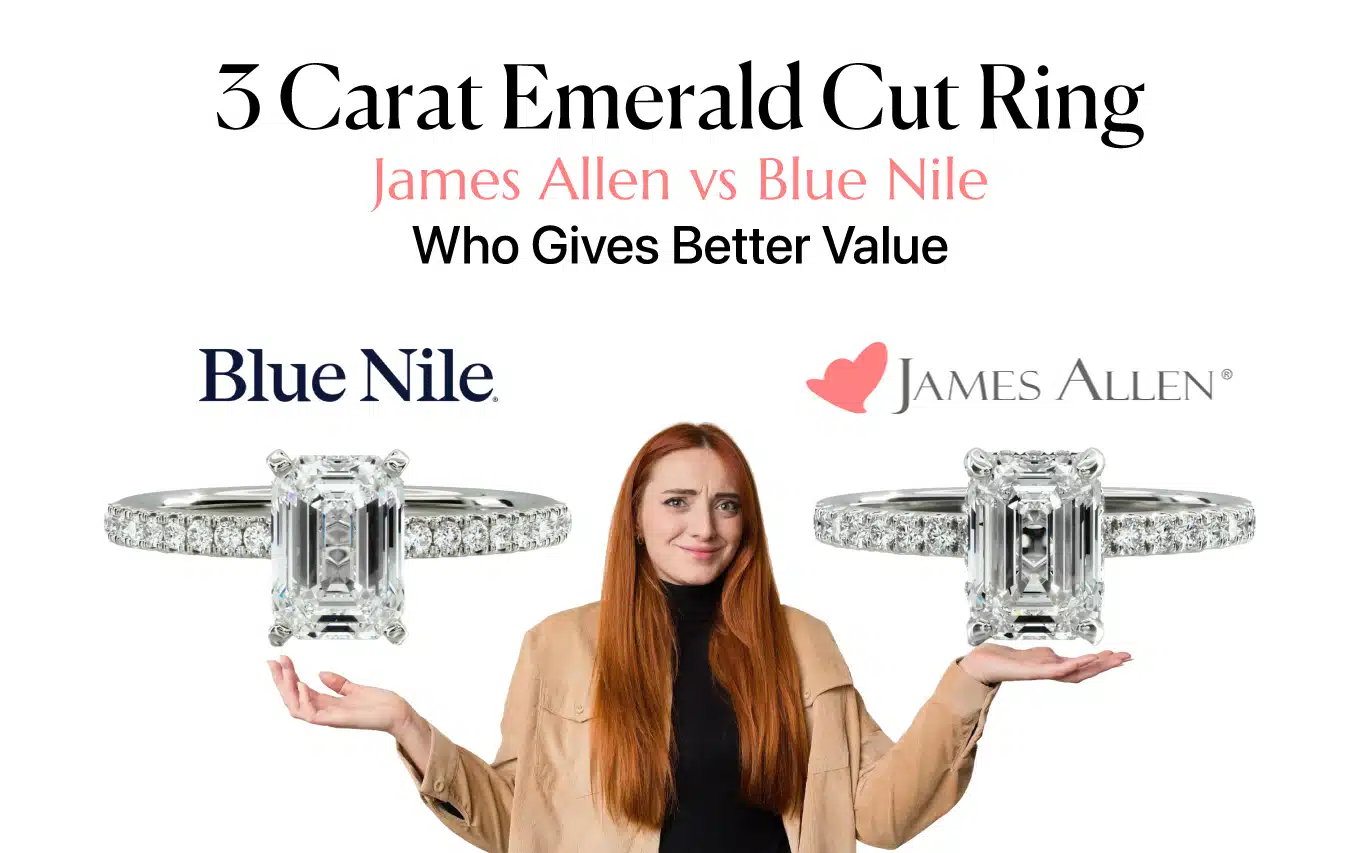
Shopping for a 3-carat diamond is a massive financial commitment. You are about to spend anywhere from $10,000 to $60,000 on a single piece of jewelry.
One tiny mistake in clarity grading or retailer choice can cost you thousands of dollars. You are not just buying a ring; you risk making a major investment completely blindfolded.
Here at Aurelia, I analyzed live-cart data to settle this debate once and for all. I will show you exactly who wins the price war and how to protect your money.
The Stakes Are Higher: Why a 3 Carat Emerald is a Different Game
Buying a 3-carat emerald cut is fundamentally different from buying a smaller brilliant cut. The rules change completely.
An emerald cut features long, open step-cut facets. This creates the famous “hall of mirrors” effect. At three carats, this effect acts like a massive, floor-to-ceiling window into the stone.
Because of this open structure, minor inclusions or flaws are highly visible. A VS2 clarity grade might look clean on a smaller round diamond. On a 3-carat emerald, it will likely show visible dark spots.
This is why I strongly advise upgrading to VS1 clarity or higher. You must guarantee the stone is completely eye-clean.
The Benchmark Showdown: Pricing a “True” 3-Carat Natural Diamond
To find the true market value, I built identical rings at both retailers. I targeted a GIA-certified, natural 3.01-carat diamond with G-Color and VS1-Clarity.
Blue Nile won the absolute final checkout price. Their completed ring cost $54,777. This victory was largely driven by lower Blue Nile setting costs.
James Allen came in slightly higher at $56,240. However, for that nearly identical loose diamond price, James Allen offered a technically superior VVS1 stone.
When buying natural stones of this size, the James Allen 360 video inspection tool is vital. You must verify the inclusion placement with your own eyes before spending $50,000.
Natural vs. Lab-Grown at 3 Carats: The $47,000 Difference
The lab grown vs natural 3 carat price gap is absolutely staggering. I used the custom ring builder on both sites to test this.
I selected a flawless 3-carat lab-grown diamond with E-Color and VVS1 clarity. I paired it with a Platinum Riviera Setting.
The identical natural ring at Blue Nile was $54,777. The lab-grown version was only $7,497. The visual difference is zero. The financial difference is over $47,000.
My #1 Secret for Natural Diamonds: The “Buy Shy” Strategy
If you insist on a natural diamond, you must use the buy shy diamond strategy. This is my top financial hack.
Diamond prices jump exponentially at the 3.00-carat mark. This is the “magic number” premium based purely on human psychology.
Instead of buying a 3.01ct stone, buy a 2.95ct stone. It is physically impossible to see the size difference with the naked eye. However, avoiding that carat weight premium will instantly save you roughly $10,000. This strategy turns an emotional purchase into a highly calculated investment piece.
The Final Verdict: Which Retailer is Better for You?
Your final decision depends on your origin preference. A direct price comparison reveals a split victory.
If you want a truly eye clean emerald diamond from the earth, James Allen wins. Their inspection tech is non-negotiable for that level of risk. If you want lab-grown, Blue Nile often wins the final cart price.
| Retailer | Best For | Price Advantage | Tech Advantage |
| James Allen | Natural Diamonds & High Clarity | Cheaper loose lab diamonds. | Superior 360° HD video inspection. |
| Blue Nile | Lab-Grown & Budget Settings | Cheaper final lab-grown ring price. | Standard 360° viewing available. |
Frequently Asked Questions Before You Buy
Which is better for a 3 carat diamond, James Allen or Blue Nile?
For natural 3-carat diamonds, James Allen is better due to their superior 360-degree viewing technology. For lab-grown diamonds, Blue Nile frequently offers a better final checkout price overall.
James Allen allows you to perfectly verify clarity, which is crucial for natural emerald cuts. Blue Nile’s ring settings are generally more affordable, making their total lab-grown packages highly competitive.
What is a good price for a 3 carat emerald cut diamond ring?
A high-quality, natural 3-carat emerald cut ring costs between $45,000 and $60,000. A premium lab-grown 3-carat emerald diamond drastically drops the price to between $7,000 and $10,000.
These prices assume you are selecting premium clarity (VS1 or higher) and excellent color grades. Setting choices, like platinum versus 14k gold, will also shift the final cost.
What clarity is best for a 3 carat emerald cut diamond?
For a 3-carat emerald cut, VS1 clarity or higher is strongly recommended. The large, open step-cut facets act like a clear window, magnifying any internal flaws.
Natural inclusions are much more visible to the naked eye in an emerald cut than they would be in a brilliant round stone. You cannot compromise on clarity at this size.
What is the “buy shy” diamond strategy?
The “buy shy” strategy involves purchasing a diamond weighing slightly below a major whole number, like 2.95 carats instead of 3.00 carats, to save thousands of dollars.
This visually identical stone avoids the massive psychological price premium attached to the 3-carat mark. It is the single best way to optimize your budget for a natural diamond.
Are James Allen lab grown diamonds cheaper than Blue Nile?
James Allen’s loose lab-grown diamonds are often cheaper than Blue Nile’s comparable stones. However, Blue Nile’s engagement ring settings are frequently less expensive.
You must compare the final, all-in price of the diamond plus the setting. A cheaper loose diamond means nothing if the setting price wipes out your savings.
