

How Mass Layoffs Are Reshaping America’s Workplace
After waves of tech layoffs, companies and workers are finding a new path forward through flexible workspace solutions
The numbers are stark and sobering. Over 182,000 tech workers have been laid off in 2025 alone, following 239,000 layoffs in 2024. Microsoft, Meta, Intel, Amazon, Salesforce—no company has been immune to the cost-cutting wave that’s swept across the industry. But from this disruption, a surprising trend is emerging: 2026 is shaping up to be the year when hybrid work stops being debated and starts being optimized.
As traditional office models crumble under economic pressure and companies reassess their real estate footprints, a new workspace paradigm is taking hold. Welcome to the era of the hybrid office—where flexibility isn’t a perk, it’s the foundation.
The Perfect Storm: Layoffs Meet Evolution
The tech industry’s recent turbulence tells a compelling story. According to Crunchbase News, at least 126,101 workers at U.S.-based tech companies were laid off in mass job cuts through 2025, with cuts anticipated to continue into 2026. The reasons are multifaceted: post-pandemic overhiring corrections, economic uncertainties, rising interest rates, and an aggressive pivot toward AI-driven efficiency.
Microsoft alone laid off approximately 6,000 workers in 2025—nearly 3% of its workforce—while Meta announced plans to cut 5% of employees as part of “performance optimization.” Intel is planning to reduce its workforce by 15% over time, targeting cost savings of $10 billion by 2025 and an additional $1 billion in 2026.
But here’s where the story takes an unexpected turn. While companies are cutting headcount, they’re not cutting their commitment to flexibility. In fact, according to Robert Half’s research, hybrid job postings have grown from 21% in Q3 2023 to 24% in Q3 2025, with fully on-site positions declining from 68% to 64% over the same period.
“The pandemic really saw a huge shift, but what we’re seeing now is a maturation of that shift,” explains Brian Elliott from the Future Forum. “Companies that focus on developing hybrid work norms at the business function level are getting more traction with employees.”
The Data Speaks: Hybrid Is Here to Stay
The numbers paint an undeniable picture. According to McKinsey, 90% of businesses plan to adopt some form of hybrid work model. More critically, 77% of companies now operate hybrid models, according to multiple industry studies. The global coworking market, valued at $22.01 billion in 2024, is projected to explode to $82.12 billion by 2034—a 14.1% annual growth rate that signals fundamental transformation rather than temporary adjustment.
Recent research from Owl Labs confirms what many suspected: hybrid work isn’t going anywhere. Their 2025 State of Hybrid Work report found that if hybrid or remote workers were no longer allowed to work flexibly, 40% would immediately start looking for another job. Meanwhile, 92% of employees cite supportive management as almost as important as pay itself.
The corporate world is taking notice. WeWork’s Business Leader Survey revealed that 59% of businesses plan to expand their office space through coworking solutions in the next two years. Companies like Allstate have made headlines by trading their headquarters for coworking memberships, giving employees the flexibility to work where it makes the most sense.
Enter the Flexible Workspace Revolution
This is where companies like Mindspace are changing the game. As a global boutique flexible workspace provider, Mindspace offers exactly what the post-layoff, hybrid-first world demands: premium workspaces across multiple cities and countries where distributed teams can work seamlessly, no matter where they’re based.
With locations spanning from Downtown Miami and Wynwood to London, Tel Aviv, Berlin, Warsaw, Bucharest, and beyond, Mindspace provides what CEO Dan Zakai calls “the right environment for both entrepreneurs and companies to host business events, organize offsites, work from our spaces, and connect with like-minded top leaders.”
The value proposition is clear. Instead of committing to expensive long-term leases in multiple cities, companies can give their global teams access to professional workspace anywhere they need it. A developer in Berlin, a product manager in Miami, and a sales director in London can all work from high-quality Mindspace locations, maintaining company culture while embracing geographic flexibility.
What Makes Hybrid Work in 2026?
The successful hybrid models emerging for 2026 share several key characteristics:
Function-Based Flexibility: Rather than one-size-fits-all policies, forward-thinking companies are letting teams decide when and why they need to be together. Sales teams might gather three days a week for training and collaboration, while engineering teams spread across time zones might convene one week per month for intensive sprint planning.
Technology-Enabled Spaces: The coworking spaces thriving in 2025 aren’t just providing desks—they’re offering smart office systems with IoT integration, AI-powered room booking, seamless video conferencing, high-speed connectivity, and collaborative tools that make remote and in-person work equally effective.
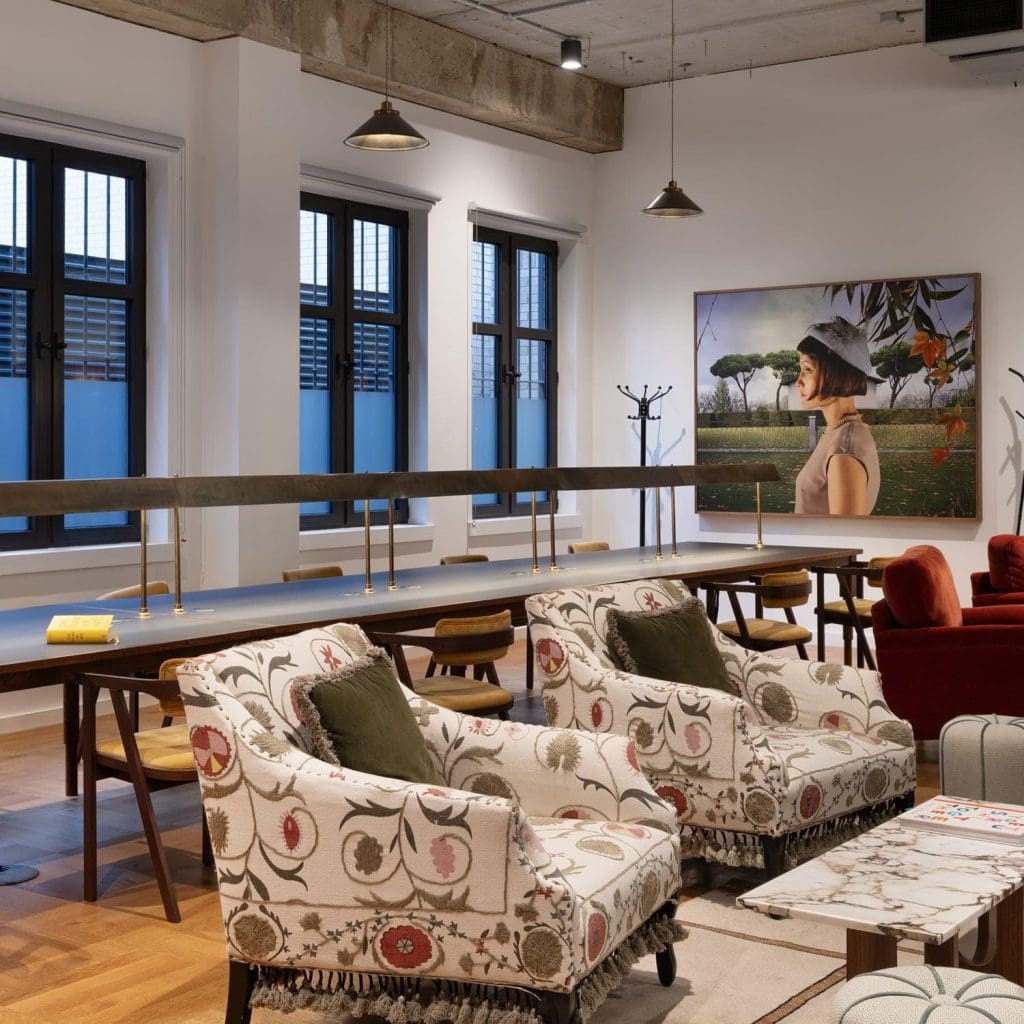
Hospitality-First Approach: Modern flexible workspaces have learned from the hotel industry. Mindspace and similar providers offer gourmet catering, wellness rooms, concierge services, member events, and design-forward environments that make people actually want to come to the office.
Proximity to Home: The explosive growth in suburban coworking (New Jersey saw 36% year-over-year growth in coworking inventory) reflects workers’ desire to avoid long commutes while maintaining professional workspace. Tertiary markets like Indianapolis and Nashville grew coworking inventory by 40% and 35% respectively.
The Financial Logic
For companies navigating uncertain economic conditions, the math is compelling. According to Cushman & Wakefield, U.S. flexible office space represents just 2% of total office supply—leaving enormous room for expansion. Meanwhile, corporate use of flexible workspace has jumped to 55% of corporations now utilizing these solutions.
Consider the economics: Instead of a 10-year lease on 50,000 square feet in Manhattan at premium rates, companies can provide employees with flexible memberships to global coworking networks. Employees get professional workspace closer to home or while traveling. Companies get predictable monthly costs, geographic flexibility, and the ability to scale up or down based on actual needs.
“It’s about being asset-light and staying agile,” explains a venture capitalist from Fuel Venture Capital. “Especially in unpredictable times, coworking offers a scalable, cost-efficient solution that removes the burden of long-term leases while still providing the collaborative environments teams need.”
The Employee Experience
For workers navigating the post-layoff landscape, hybrid work offers something precious: control. After experiencing the trauma of massive layoffs, employees are prioritizing flexibility, work-life balance, and the ability to choose where they work.
The Owl Labs report found that most hybrid workers prefer spending three days in the office per week—a “3-2 model” that’s becoming the de facto standard. But critically, they want that flexibility protected. Some 43% of hybrid employees admitted to “coffee badging”—showing up at the office briefly just to be seen before leaving to work elsewhere.
The message is clear: mandates don’t work. Companies trying to force full-time return-to-office are hemorrhaging talent. Research shows RTO mandates lead to brain drain, particularly driving out top performers and women with childcare responsibilities.
The Global Advantage
Perhaps the most compelling aspect of 2026’s hybrid office model is its international dimension. With platforms like Mindspace operating across continents, companies can truly build global teams without sacrificing collaboration or culture.
A startup might have its CEO in New York, developers in Warsaw, designers in London, and sales teams in Miami—all working from premium Mindspace locations with consistent quality, amenities, and community. Team members can travel between cities and always have professional workspace waiting. Companies can host offsites in different locations, exposing teams to new markets and cultures.
This geographic flexibility is particularly valuable in a post-layoff world where top talent is reevaluating their priorities. The ability to live in a lower-cost city or closer to family while maintaining career trajectory is increasingly non-negotiable for high performers.
Looking Ahead
As we move into 2026, several trends are converging to make hybrid work not just viable but optimal:
AI Integration: Advanced AI tools are automating routine tasks, freeing employees to focus on collaboration and creativity—activities best done in person with colleagues.
Sustainability Focus: Fewer daily commutes and optimized real estate usage align with corporate ESG goals. Coworking spaces increasingly pursue WELL certification and B Corp status.
Results-Oriented Management: Companies are finally moving from measuring hours worked to measuring outcomes achieved. This shift requires trust—and works best in hybrid environments.
Wellness Priority: Mental health support, fitness amenities, and work-life balance are no longer perks but necessities for talent retention.
The data suggests we’re not looking at a temporary trend but a fundamental restructuring of work itself. By 2030, analysts predict roughly 30% of office space globally will be under flexible leases, up from 8-10% pre-pandemic.
The Choice Is Clear
For companies and employees emerging from the layoff wave of 2024-2025, the path forward is crystallizing. The rigid structures of the past—massive headquarters, long-term leases, five-day office weeks—are giving way to something more adaptive, more humane, and ultimately more sustainable.
2026 won’t be remembered as the year work went back to normal. It will be remembered as the year we stopped trying to recreate 2019 and started building something better. The hybrid office, supported by flexible workspace solutions like those offered by Mindspace, represents more than a trend—it’s the future of work, arriving right on schedule.
For global teams seeking to thrive in this new era, the message is simple: flexibility isn’t optional anymore. It’s how work gets done.
