
1) Introduction
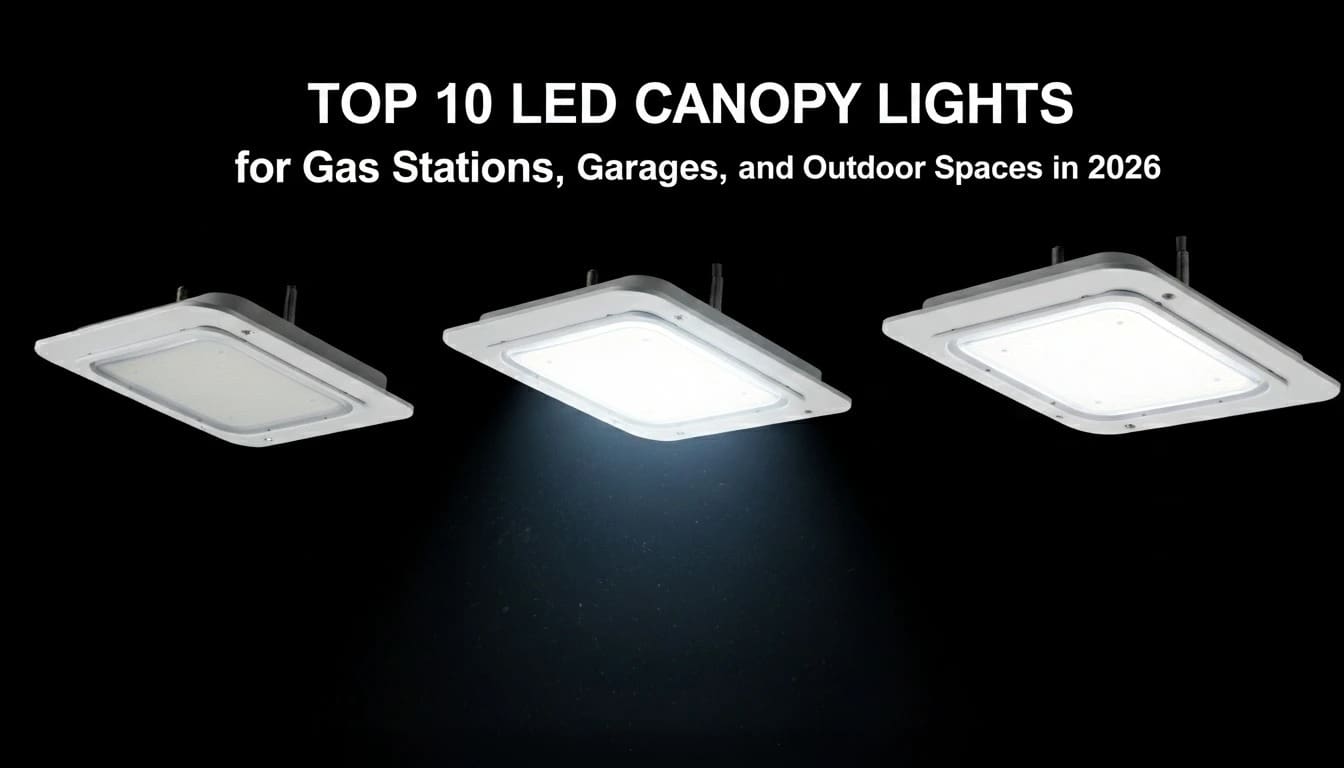
LED Canopy Lights are the go‑to choice for forecourts, parking garages, and covered walkways in 2026. They deliver bright, uniform illumination with lower energy use and longer lifespans than HID. Business‑ready durability, motion sensing, and 0–10V dimming help cut operating costs while improving visibility and safety. This guide spotlights energy‑efficient lighting options tailored to gas stations, garages, and outdoor spaces so you can short‑list commercial outdoor lights that make sense for your next LED upgrades in 2026.
2) Why LED Canopy Lights Are Ideal for 2026
- Smarter controls: Today’s fixtures pair with wireless networks, smartphone apps, and onboard sensors for adaptive light levels and automated scheduling. Several models support Bluetooth or enterprise systems to trim kWh without sacrificing visibility.
- Lower total cost of ownership: High efficacy (often >120 lm/W) and long L70 lifetimes limit energy and maintenance spend. Many are DLC® Premium‑listed for utility rebates.
- Better visual comfort: Optics engineered for canopies reduce glare while throwing light exactly where people move, including between pump and store.
- Reliability outdoors: Weather ratings like IP65/IP66, impact‑resistant lenses, and corrosion‑resistant housings withstand rain, dust, and daily abuse.
3) Key Factors to Consider Before Buying
- Wattage and brightness: requirements need to match lumen output with mounting height, target foot-candles, and safety standards.
- Color temperature and uniformity: requirements need to achieve 4000K–5000K because this range produces clear visual differentiation without creating bright light reflections. The photometric data needs to be checked for uniform distribution.
- Ingress protection & Construction: IP65/66, sealed optics, and robust housings extend service in wet, dusty, or cold environments.
- Controls: Prefer fixtures with 0–10V dimming, motion sensors, photocells, or wireless networks for scheduling and demand control.
- Certifications: Look for UL/cUL listings and DLC® (often DLC Premium) to streamline rebate eligibility.
4) Comparison Table: Quick Buyer’s Guide
5) Installation & Maintenance Tips
- Plan the photometrics: Model mounting height, target average foot‑candles, and uniformity ratios before you buy.
- Use the right accessories: Beauty plates, retrofit panels, and mounting brackets speed change‑outs and hide legacy discoloration.
- Commission controls: Set motion/photocell thresholds and dimming levels to balance safety with savings; use vendor apps where available.
- Seal and protect: Follow gasketing and torque specs to preserve IP ratings and prevent water ingress over time.
- Document settings: Record lumen settings, CCT, and control profiles for faster future maintenance.
6) Where to Buy LED Canopy Lights in 2026
In the event that you modernize your lighting arrangement in 2026, the selection of a reliable supplier will be the most important thing, and Super Tech LEDs is the place where you can get the best LED Canopy Lights that are made for gas stations, garages, and outdoor commercial areas. We combine everything you want in lights: high lumen efficacy, advanced thermal management, and durable IP65/IP66 rated design to provide reliable and energy-efficient lighting. Every fixture is UL-listed and DLC Premium-certified, assuring great performance, safety, and qualification for energy rebates. If you are handling a large commercial property, municipal land, or industrial area, Super Tech LEDs will provide you with customized lighting solutions along with expert support, bulk price advantages, and prompt shipping. Backed by strong warranties and exceptional after-sales support, we help businesses transition to smarter, more sustainable lighting, making Super Tech LEDs the trusted choice for professional-grade LED canopy lighting in 2026.
7) Conclusion
Upgrading to LED canopy lights in 2026 boosts safety, trims utility bills, and simplifies maintenance across gas stations, municipal garages, industrial sites, recreation venues, and event facilities. The ten models above span high‑output forecourt luminaires, compact garage workhorses, and weather‑proof champions with smart control options. Choose a solution aligned with your mounting heights, target foot‑candles, and controls strategy, and make your lighting a durable asset rather than a recurring expense.
FAQs
Q1: How many lumens do I need for a gas station canopy?
Target illumination often falls between 20–30 fc at grade with good uniformity; that typically means 10K–20K lumens per fixture at common canopy heights. Always confirm with a photometric layout for your site.
Q2: 4000K or 5000K for canopies?
Both work well. 4000K offers balanced visibility with less perceived glare; 5000K maximizes contrast and “daylight” appearance for branding.
Q3: What IP rating should I look for?
IP65 or IP66 is common for exposed canopies; IP68 is desirable in harsh washdown environments. Verify housing and lens ratings in the spec sheet.
Q4: Do motion sensors really save money in busy sites?
Yes, dim‑to‑low during lulls yields measurable savings, especially overnight, without compromising safety. Look for integrated sensors or wireless control compatibility.
Q5: Which certifications matter most for rebates?
DLC® (often Premium) is the typical requirement, along with proper UL/cUL listings for safety. Check the DesignLights Consortium® QPL for the exact catalog number you plan to buy.
Who this guide is for
- Business & Commercial Property Owners: reduce OPEX with smart dimming and high efficacy.
- Public Sector & Municipalities: standardize on DLC‑listed, low‑glare fixtures for safer public garages.
- Industrial & Construction: choose rugged, IP‑rated housings and sealed optics for reliability.
- Sports & Recreation Facilities: improve wayfinding and security in covered entries and concourses.
- Event & Entertainment: elevate guest experience with uniform, low‑glare lighting at drop‑offs and canopies.