

Semi-truck suspension work isn’t something you do with a standard socket set and a prayer. The fasteners holding leaf springs, torque arms, equalizer beams, and trunnion assemblies together on a Class 8 truck are massive — and many of them require a 1-7/8″ wrench for semi-truck suspension jobs that no other size will fit. If you’ve ever tried to improvise with an adjustable wrench or a “close enough” metric socket on one of these bolts, you already know how badly that can end.
The 1-7/8 inch dimension shows up repeatedly across heavy-duty truck suspension systems made by Hendrickson, Mack, Peterbilt, Kenworth, and Freightliner. It’s the size you need for specific equalizer bolt nuts, certain torque rod hardware, trunnion shaft retaining nuts, and various suspension mounting fasteners that bear the full weight and road stress of an 80,000-pound loaded vehicle. Getting these fasteners right isn’t just about convenience — it’s about safety.
This guide covers everything you need to know about choosing, using, and maintaining a 1-7/8″ wrench for semi-truck applications. We’ll look at where this size appears on real truck suspensions, why the right wrench type matters so much for these specific fasteners, and what separates a tool that handles the job from one that fails when you need it most.
Where the 1-7/8″ Size Appears on Semi-Truck Suspensions
Semi-truck suspensions are engineered to absorb punishment that would destroy a passenger vehicle in weeks. The fasteners used in these systems reflect that reality — they’re large, they’re high-strength, and they’re torqued to specifications that push hand tools to their limits. The 1-7/8 inch hex dimension appears on several critical components.
Equalizer Beam and Rocker Arm Hardware
On tandem-axle trucks running leaf spring suspensions, the equalizer beam (sometimes called a walking beam or rocker arm) connects the front and rear axle spring assemblies and allows them to articulate independently. The bolts and nuts securing this assembly often require a 1-7/8″ wrench for semi-truck service. These fasteners must maintain precise clamping force because the equalizer pivots constantly as the truck moves over uneven surfaces. A loose equalizer bolt can cause the entire rear suspension geometry to shift, leading to uneven tire wear, handling problems, and accelerated component failure.
Trunnion Shaft and Bushing Assemblies
The trunnion shaft is the pivot point for the rear suspension on many heavy-duty trucks. It carries the full vertical load of the rear axles and distributes that force to the truck frame. Retaining nuts on trunnion shafts frequently fall in the 1-7/8 inch range, and they require significant torque — often 400 to 600 ft-lbs depending on the manufacturer’s specification. Getting these wrong during a rebuild can cause catastrophic suspension failure under load.
Torque Rod Mounting Hardware
Torque rods (also called torque arms or radius rods) control axle alignment and prevent the axle from rotating under braking and acceleration forces. On some Class 8 configurations, the mounting hardware for these rods uses 1-7/8 inch fasteners. Because torque rods directly affect axle alignment, any damage to these fasteners during service — rounding, stretching, or improper torque — translates directly into alignment problems, premature tire wear, and reduced vehicle stability.
Spring Hanger and Shackle Bolts
Certain heavy-duty spring hanger designs use 1-7/8 inch bolts to secure the hangers to the frame. These are among the most heavily loaded bolts on the entire truck, bearing the combined weight of the payload and the dynamic forces generated by road impacts, braking, and cornering. Some Mack and Hendrickson suspension designs specifically call for this fastener size on hanger bracket assemblies.
Why You Need a Dedicated 1-7/8″ Wrench (Not an Adjustable)
It’s tempting to reach for a large adjustable wrench when you encounter an oddball fastener size. In lighter applications, that might work. On semi-truck suspension hardware, it’s a genuine mistake. Here’s why.
Adjustable wrenches introduce jaw flex. Even the best adjustable wrench has some play between the fixed and movable jaw. Under the torque loads found on suspension fasteners — we’re talking 400 to 600 ft-lbs on many components — that flex allows the tool to shift on the fastener head. The shifting concentrates force on two corners of the hex instead of distributing it across all six faces. The result is rounded bolt heads, which turn a routine service job into a nightmare involving bolt extractors, cutting torches, or both.
A dedicated wrench distributes load evenly. A proper box-end or ratcheting 1-7/8″ wrench for semi-truck work grips all six faces (or twelve, depending on the point count) of the fastener simultaneously. That even load distribution protects the bolt head and allows you to apply maximum torque without slippage or damage.
Repositioning time adds up fast. Semi-truck suspension components often sit in tight spaces between frame rails, cross members, and air tanks. An open-end wrench or adjustable wrench requires lifting and repositioning after each partial turn. A ratcheting wrench eliminates that cycle, saving significant time on every fastener — and when you’re working on an entire suspension overhaul with dozens of large bolts, that time savings is substantial.
IRONCUBE makes a purpose-built 1-7/8 inch friction wrench that addresses all three of these problems. Its friction-type ratcheting mechanism handles high-torque applications without the gear-tooth stripping risk that plagues conventional ratchets at this size, and the chrome vanadium steel construction resists deformation under the loads that semi-truck suspension work demands.
Friction Ratcheting vs. Gear Ratcheting: Why It Matters at This Size
The ratcheting mechanism inside a wrench becomes critically important once you move beyond standard sizes. For a 1-7/8″ wrench for semi-truck applications, the difference between friction and gear ratcheting can determine whether the tool handles the job or fails mid-task.
How Gear Ratchets Fail Under Extreme Torque
Traditional ratcheting wrenches use a gear-and-pawl system with interlocking teeth. When you apply force in the driving direction, the pawl engages the gear teeth and transfers torque to the fastener. When you reverse the handle, the pawl skips over the teeth and resets. This system works beautifully for standard-size fasteners where torque loads are moderate.
At semi-truck suspension torque levels, those gear teeth become a liability. The shear forces on individual teeth at 400+ ft-lbs can exceed the metal’s yield strength, especially after repeated use or in cold weather when steel becomes more brittle. When a gear tooth strips, the wrench slips without warning — a dangerous situation when you’re applying maximum force.
How Friction Ratchets Handle the Job
Friction ratcheting mechanisms replace the gear teeth with friction surfaces that grip in one direction and release in the other. Because the load is distributed across a broad friction surface rather than concentrated on individual teeth, the mechanism handles extreme torque without the stripping risk. The entire IRONCUBE friction wrench lineup uses this approach, and it’s a deliberate design choice for professional tools that serve heavy-duty applications.
For a detailed comparison of ratchet wrench options for heavy equipment, see this guide on big ratchet wrenches for heavy equipment.
| Feature | Friction Ratchet | Gear Ratchet |
|---|---|---|
| Load distribution | Broad friction surface | Individual gear teeth |
| Torque capacity | Excellent for 400+ ft-lbs | Risk of stripping above 300 ft-lbs |
| Wear behavior | Gradual, predictable | Sudden tooth failure |
| Debris tolerance | High — fewer places for grit to jam | Low — debris damages teeth |
| Noise | Quiet, smooth | Clicking during operation |
| Best for | Semi-truck, mining, industrial | Automotive, light commercial |
What to Look for When Buying a 1-7/8″ Wrench for Truck Suspension
Not every 1-7/8″ wrench will perform the same under the demands of semi-truck maintenance. Here are the features that separate a reliable professional tool from a liability.
Chrome Vanadium Steel Construction
The wrench must be forged from chrome vanadium steel (CrV), the industry-standard alloy for professional hand tools. CrV provides the combination of hardness and toughness that suspension work demands — hard enough to resist deformation at the contact points, tough enough to absorb impact loads without cracking. Some budget wrenches use unmarked steel or plain carbon steel, and both will let you down eventually. At this size and torque level, material quality is non-negotiable.
12-Point Box End with Off-Corner Loading
A 12-point box end engages the fastener every 30 degrees of rotation. In the tight spaces between semi-truck frame rails, that fine engagement angle means you can often get the wrench started where a 6-point design wouldn’t fit. Off-corner loading geometry is equally important — it contacts the flat faces of the bolt head rather than the corners, distributing force evenly and protecting against rounding. For suspension bolts that may already show some wear from previous service, this protection is invaluable.
Extended Handle Length
At 1-7/8 inches, you need serious leverage to achieve the torque specifications that suspension manufacturers require. The handle should be long enough to generate 400 to 600 ft-lbs without a cheater bar. A wrench that’s too short forces you to either under-torque the fastener (creating a safety risk) or use an extension pipe (which overloads the wrench beyond its design limits). The IRONCUBE 1-7/8″ friction wrench is designed with the handle proportions that match the torque demands of this fastener size.
Black Oxide or Corrosion-Resistant Finish
Semi-truck shops are not clean rooms. The wrench will encounter grease, road grime, hydraulic fluid, and moisture on every job. A durable surface finish — black oxide, phosphate coating, or satin chrome — protects against corrosion and provides better grip than bare polished steel.
Step-by-Step: Using a 1-7/8″ Wrench on Suspension Components
Proper technique matters as much as proper tools when working on semi-truck suspensions. These steps apply to most suspension fastener service involving a 1-7/8″ wrench for semi-truck applications.
Secure the vehicle before starting. Support the truck on jack stands or use a shop lift rated for the vehicle’s weight. Never work under a semi-truck supported only by a hydraulic jack. Block the wheels on the opposite end of the truck to prevent rolling.
Clean the fastener before applying the wrench. Road grime, rust scale, and paint buildup on bolt heads reduce the wrench’s contact surface and increase the risk of slipping. A wire brush and a shot of penetrating lubricant take 30 seconds and prevent rounding that could cost hours to fix.
Apply penetrating oil to corroded fasteners. Suspension bolts on trucks that run in northern climates or coastal areas are frequently corroded. Spray the threads and bolt head generously with penetrating oil and let it soak for 15 to 30 minutes before attempting removal. For severely seized bolts, apply heat with a propane torch to expand the surrounding metal before turning.
Pull toward you, not away. When applying torque, always pull the wrench handle toward your body rather than pushing away. If the bolt suddenly breaks free, a pulling motion lets you absorb the force naturally. A pushing motion can cause your fist to strike nearby components — and on a semi-truck, those components are heavy steel with sharp edges.
Follow manufacturer torque specifications exactly. Under-torquing creates loose joints that fail under load. Over-torquing stretches the bolt beyond its elastic limit, weakening it and causing eventual fatigue failure. Use a calibrated torque wrench for final tightening. Your 1-7/8″ wrench for semi-truck work is the right tool for removal, installation, and snugging — but final torque verification should always involve a calibrated instrument.
Re-torque after initial service. Most truck manufacturers recommend re-torquing suspension fasteners after the first 500 to 1,000 miles of service. New components settle, springs compress, and bushings seat — all of which can reduce clamping force even when the initial torque was correct.
For a broader set of safety guidelines applicable to large wrench use, read this guide on how to use flex-head ratchet wrench sets safely.
Complementary Tools for Semi-Truck Suspension Work
A 1-7/8″ wrench for semi-truck suspension is essential, but it’s one piece of a larger toolkit. Semi-truck suspension overhauls involve fasteners ranging from standard bolt sizes up to the largest jumbo dimensions. Here’s how to build out a complete suspension tool set.
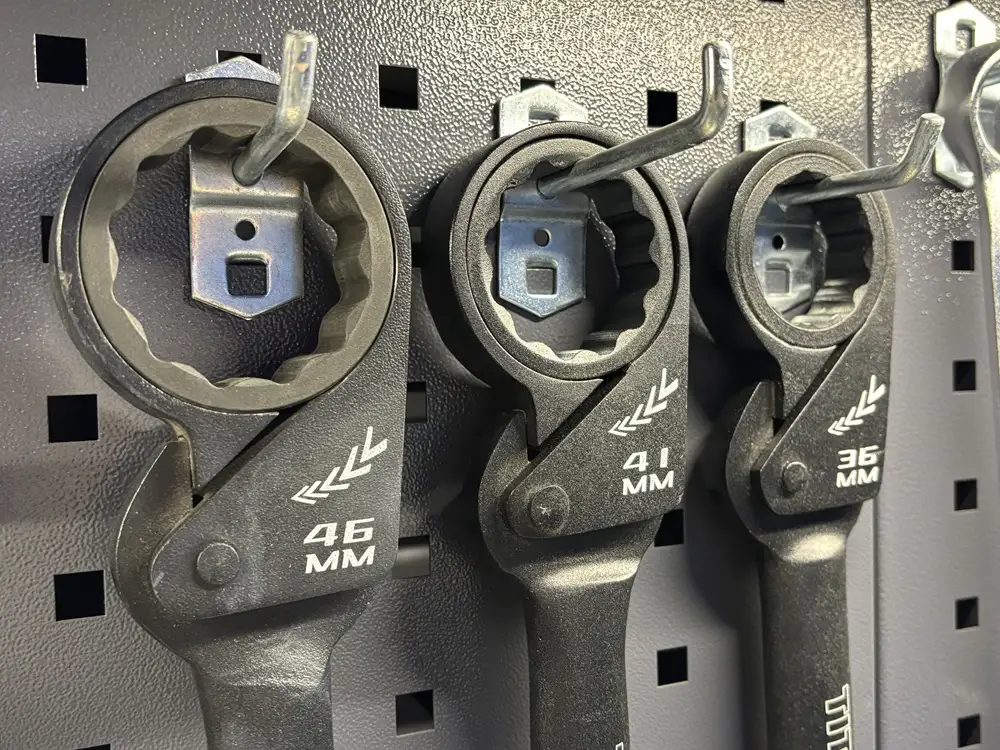
Cover the full jumbo range. In addition to 1-7/8 inch, you’ll likely encounter 1-1/2 inch, 1-5/8 inch, and 2-1/4 inch fasteners on various suspension components. IRONCUBE offers friction wrenches across this range, including the 1-1/2 inch model and the 2-1/4 inch wrench for the largest fasteners you’ll encounter. On the metric side, many European-origin trucks and some Freightliner models use metric fasteners, so having a 36mm friction wrench, 41mm jumbo spanner, and 46mm ratcheting wrench ensures complete coverage.
Add flex-head wrenches for tight access. Frame rails, air tanks, and cross members often block straight-line access to suspension bolts. A flex-head ratcheting wrench lets you angle the head to reach fasteners that a straight wrench can’t. Learn how flex-head ratchet wrench sets save time on auto repairs — the same principles apply to heavy truck work.
Include a quality general-purpose set. Not every fastener on the suspension system is jumbo-sized. U-bolt nuts, shock absorber mounts, and various brackets use standard-size hardware. IRONCUBE’s 53-piece ratcheting screwdriver set covers the smaller drive types, and you can browse their full tool range on the IRONCUBE Amazon storefront.
For heavy-duty flex-head options specifically designed for industrial environments, see this guide on heavy-duty flex-head ratchet wrench sets for industrial use.
Procurement and Fleet Shop Considerations
If you’re managing a fleet maintenance operation or outfitting a truck repair shop, buying large wrenches at scale requires a different approach than individual purchases.
Standardize on one brand across the shop. When every technician uses the same tool models, training is consistent and replacement ordering is simple. IRONCUBE Works manufactures hand tools for over 600 brands globally, which means consistent quality at production scale. You can contact their team directly for wholesale pricing and custom branding options.
Stock both imperial and metric in the jumbo range. Modern semi-truck fleets often mix American-designed and European-designed vehicles. Freightliner, Volvo, and certain Kenworth models use metric fasteners on components that other manufacturers spec in imperial. Having both systems available prevents technicians from improvising with incorrect sizes.
Budget for tool replacement cycles. Heavy-duty wrenches used daily on semi-truck suspensions will eventually wear. Plan for replacement on a schedule rather than waiting for failure. A worn friction surface or a deformed box end reduces performance gradually before it fails outright. For guidance on sourcing quality tools in volume, check out this article on how to find quality wholesale jumbo wrench sets.
For fleet shops that also maintain agricultural equipment with similar suspension fastener sizes, this guide on jumbo ratcheting wrench sets for agriculture covers additional considerations.
Frequently Asked Questions
What specific semi-truck components require a 1-7/8″ wrench?
The 1-7/8″ wrench for semi-truck work is commonly needed for equalizer beam bolts, trunnion shaft retaining nuts, certain torque rod mounting hardware, and spring hanger bracket bolts on Class 8 trucks. The exact components vary by manufacturer and suspension design — Hendrickson, Mack, and Peterbilt models frequently use this size on critical load-bearing suspension joints that require precise torque control during service.
Can I use a 48mm metric wrench instead of a 1-7/8″ wrench?
A 48mm metric wrench measures 48.00mm across the flats, while 1-7/8″ converts to 47.625mm — a difference of 0.375mm. That gap is enough to allow slippage under the extreme torque loads found on semi-truck suspension fasteners. Always match the wrench to the actual measurement system of the fastener. If the bolt is imperial, use a 1-7/8″ wrench for semi-truck work. If it’s metric, use the correct metric size. Mixing systems risks rounding the fastener head.
Why is a friction ratcheting mechanism better than a gear ratchet for this size?
Semi-truck suspension fasteners require torque levels that commonly exceed 400 ft-lbs. Gear-tooth ratchets concentrate that load on individual teeth, which can strip under extreme force. Friction ratcheting mechanisms distribute the load across broad friction surfaces, providing reliable engagement at any torque level without the stripping risk. For a 1-7/8″ wrench for semi-truck applications, this makes friction ratchets the safer and more durable choice.
What torque specifications apply to semi-truck suspension bolts?
Torque specifications vary significantly by manufacturer, component, bolt grade, and thread condition. Most suspension bolts in the 1-7/8 inch range fall between 400 and 600 ft-lbs, but always consult the truck manufacturer’s service manual for exact figures. Factors like thread lubrication, bolt grade (typically Grade 8 for suspension hardware), and whether the fastener is being reused also affect the correct torque value. Your 1-7/8″ wrench for semi-truck service handles snugging and removal, while final torque verification should always use a calibrated torque wrench.
How often should semi-truck suspension fasteners be re-torqued?
Most truck and suspension manufacturers recommend re-torquing critical suspension fasteners after the first 500 to 1,000 miles following any service. This initial re-torque accounts for component settling, bushing seating, and spring pack compression that naturally reduce clamping force after installation. Some fleet operations also re-check suspension torques during routine preventive maintenance intervals. Having a reliable 1-7/8″ wrench for semi-truck work makes these re-torque procedures efficient and consistent.
Is the 1-7/8″ size also used outside of semi-truck suspension?
Yes. While semi-truck suspension is one of the most common applications, the 1-7/8 inch fastener size also appears on heavy construction equipment, mining machinery, marine hardware, and large industrial assemblies. Any industry that uses oversized imperial fasteners may encounter this dimension. A quality 1-7/8″ wrench for semi-truck work performs equally well in these other heavy-duty contexts.
Final Summary
The 1-7/8″ wrench for semi-truck suspension work is a specialized but essential tool for anyone who services Class 8 trucks. It covers critical fasteners on equalizer beams, trunnion shafts, torque rods, and spring hangers — components that bear the full weight and road stress of a loaded semi-truck. Choosing a friction ratcheting wrench forged from chrome vanadium steel ensures reliable performance at the torque levels these fasteners demand, while protecting bolt heads from the rounding damage that adjustable wrenches and poorly fitting tools cause. Whether you’re an independent mechanic, a fleet maintenance manager, or a truck owner handling your own service, investing in the right tool for this specific size pays for itself in safety, efficiency, and fastener preservation on every job.